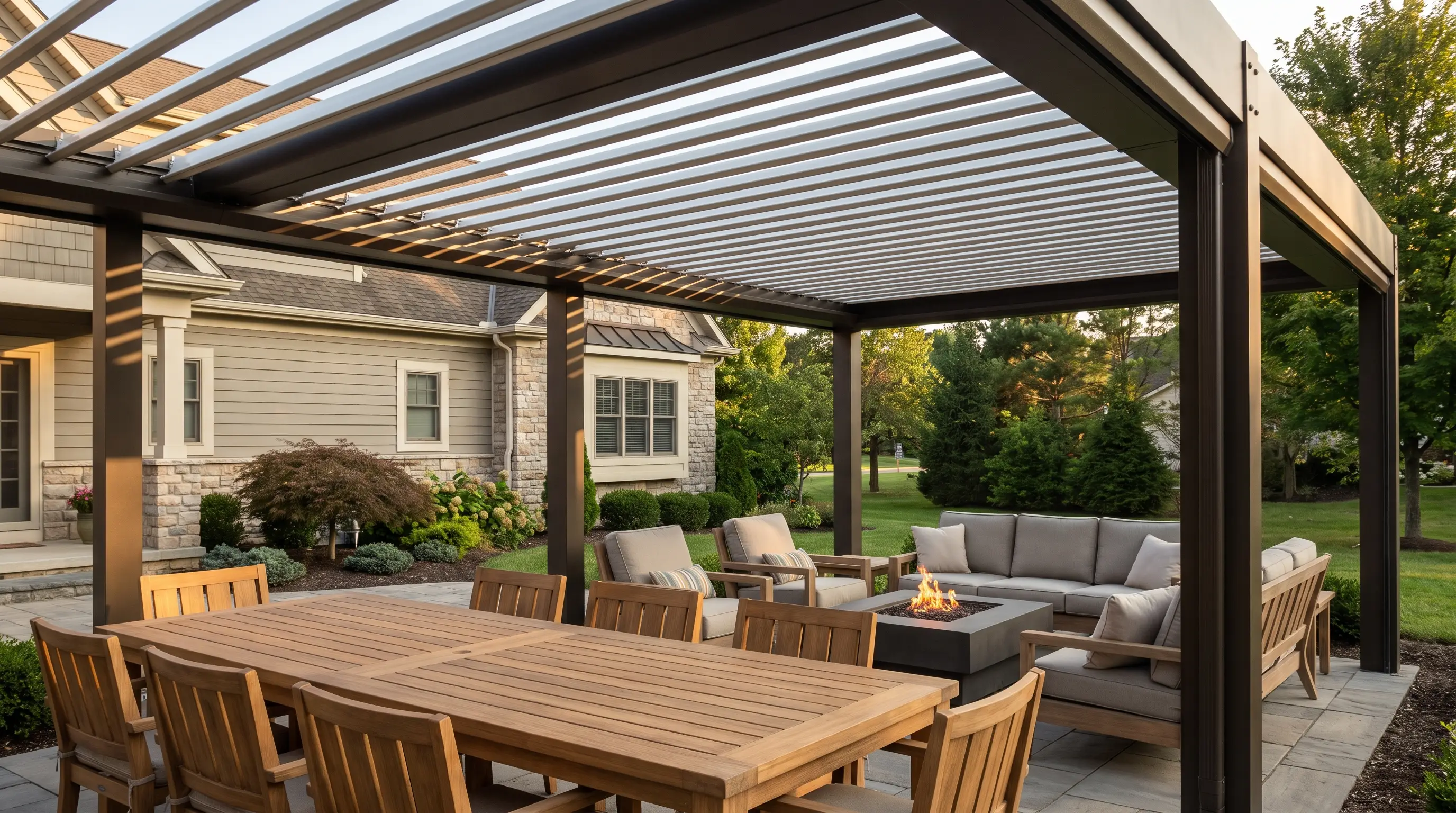
Are Louvered Pergolas Worth It? Pros, Cons, Regrets and Buyer Checklist
A louvered pergola is usually worth it when you will actually use adjustable shade and ventilation and the exact kit fits your site, weather, drainage, installation, and warranty requirements. If the roof would stay in one position most of the time, a simpler fixed structure is usually better value.
By MyPergolaMatch Research · Updated 2026-10-10
Worth it when the adjustable roof solves a real problem.
You expect to change the roof position regularly, and the exact kit fits your site, weather requirements, drainage expectations and installation plan.
The roof would stay in one position most of the time, or a simpler fixed roof solves the same shade and coverage need with less mechanical complexity.
The real value proposition
The main reason to buy a louvered pergola is not that it looks more premium. It is that the roof changes state. Open louvers can increase sun and airflow; angled louvers can tune shade; closed louvers can create more continuous overhead protection when the product is designed for it.
That flexibility only creates value when it matches how you use the patio. Buyers who want permanent coverage and rarely change the roof may be paying for a mechanism they do not need.
More likely worth it
- Shade changes through the day
- You entertain outdoors often
- You value adjustable airflow
- The site supports proper drainage and anchoring
Think twice
- Budget is the main constraint
- You want the simplest possible structure
- You rarely need roof adjustment
- Installation complexity is a major concern
Where buyers can be disappointed
Most avoidable disappointment comes from expectations that were never verified: assuming closed louvers mean zero rain intrusion, assuming a headline wind number applies without anchoring, assuming a nominal 10x12 footprint matches the real post layout, or assuming a motorized kit only needs a standard outdoor outlet.
The fix is not more marketing research. It is variant-level verification before ordering.
Manual versus motorized is a behavior question
Manual roofs reduce electrical complexity and can be a sensible choice when adjustments are occasional. Motorized roofs make frequent adjustments easier and can support sensors or smart controls, but the buyer should understand power, motor warranty, serviceability, and what happens if a component fails.
A five-question buyer checklist
Before choosing a louvered system, answer these questions in order.
- Will I actually change the roof position often?
- Does the exact size fit the site and furniture plan?
- Are wind, snow, and rain claims documented for this configuration?
- Can the site satisfy the anchoring and electrical requirements?
- Does the warranty and service path justify the extra mechanical complexity?
The quick answers.
What are the disadvantages of a louvered pergola?
Compared with a simpler fixed roof, a louvered system adds moving parts, drainage channels, alignment requirements, and sometimes motors, controls, sensors, and electrical work. It also usually costs more than a basic open-roof structure.
Do louvered pergolas leak?
They can admit water depending on the system, installation, wind direction, seals, roof position, and drainage capacity. Treat ‘waterproof’ as a product-specific claim that needs evidence, not a category-wide guarantee.
Do owners actually use the louvers?
That depends on the space and habits. Before paying for adjustability, ask how often you expect to switch between open sky, filtered sun, ventilation, and closed-roof shade. If the answer is rarely, a simpler roof may be better value.
Are motorized louvers worth it?
They can be for frequent roof adjustments, accessibility, or automation. They also add electrical and mechanical complexity. Compare the motor warranty, power requirements, controls, manual override or service path, and replacement support.
Sources & methodology
We use manufacturer and primary product sources where possible, keep unknown values unknown and do not claim hands-on testing unless it happened. Read the full methodology.