Pergola Privacy Screens: Which Type and Size Will Fit Your Kit?
Match the exact pergola series, the side you want to cover and the accessory’s current compatibility statement. A ‘10-foot’ screen is not a universal 10-foot replacement panel.
By MyPergolaMatch Research · Updated 2026-10-31
Start with the view you want to change
Sit in the chair you actually use. Identify the problem from that position: a neighbor’s sightline, low afternoon sun, insects or a preference for a more enclosed patio. Then walk the main route from the house to the yard. The best side to screen is not necessarily the easiest side to photograph.
Write one job beside each side on a sketch: privacy, shade, view or passage. Leave a side open when it has no problem to solve. This avoids buying a full enclosure when one carefully chosen screen would be enough.
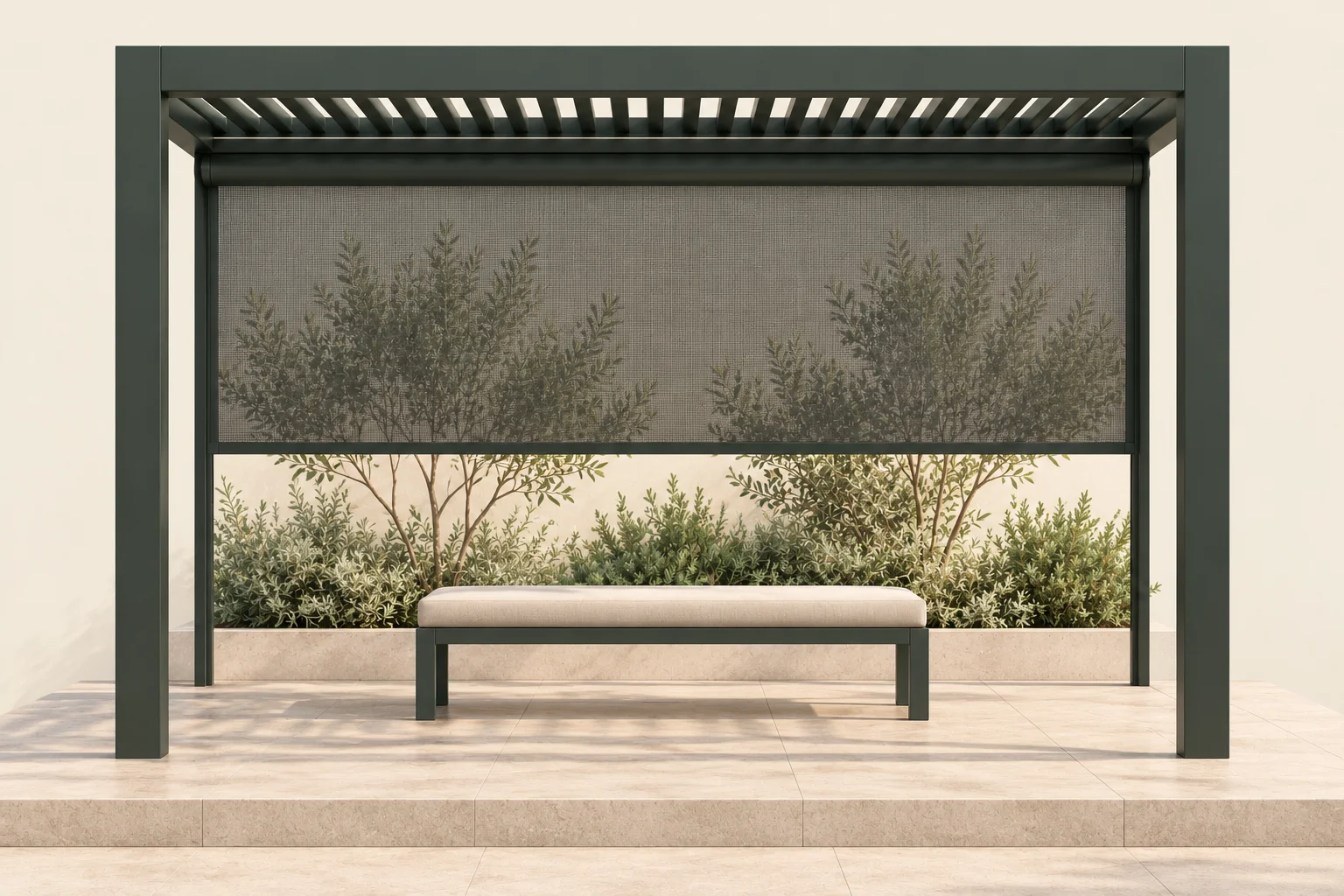
A real trap: ‘fits Mirador’ is not enough
The 111-series 10-foot pull-down screen page explicitly excludes the Sorara Mirador 8.9 × 14.4-foot pergola sold at Costco. Buying from the same retailer, or finding the same brand on the frame, does not remove that exception. Check the exact accessory page before relying on a broad accessory article.
The same page lists 110 × 4 × 93-inch and 146 × 4 × 93-inch screen dimensions for its 10-foot and 13-foot side options. These are accessory dimensions, not a direction to measure an opening and buy any panel with a similar width. Confirm the ordered option and its installation drawing.
Use this compatibility gate before adding to cart
Copy the model identifier from the frame label or manual, not just the retailer order title. Save the accessory SKU and selected size alongside it. If one of the following gates is unresolved, treat compatibility as unconfirmed—not as a close enough match.
| Gate | Record | Stop if… |
|---|---|---|
| Pergola identity | Brand, series, size, generation and mounting type | The seller confirms only the brand. |
| Target side | Sketch with the intended bay highlighted | A long side contains an intermediate post or a different opening. |
| Accessory identity | SKU, option, color and included parts | The page has an exclusion or unclear size selector. |
| Installation | Correct manual, fixing points and required clearance | The plan depends on trimming a panel or improvising brackets. |
| Quantity | Full-side kit or partial-panel count | One item is being mistaken for a complete side. |
Keep the accessory family and panel count straight
Mirador maintains a separate 80/88 accessory collection with 10-foot and 12-foot side screens. A 10-foot option in that collection is not interchangeable with a 10-foot 111-series option merely because the nominal label matches. Use the 80S catalog example below to identify a starting model, then verify the specific accessory against its documentation.
Mirador’s accessory guidance also distinguishes one-third-bay shutter or decorative panels from a full-side screen. Its example uses three one-third panels to cover a compatible side. Confirm whether the current package is one panel or a multi-panel kit; do not multiply the pergola’s nominal side length into an invented custom panel size.
Choose the function before the material
Mirador describes retractable screens as a flexible shade/privacy option and glass doors as a more substantial semi-enclosure. It also states that these additions do not turn a pergola into an insulated, sealed indoor room. Treat comfort, visibility and weather protection as separate requirements.
Ask for material samples or an in-person demonstration when privacy is critical. Compare the view from both sides at the lighting conditions you care about. A product photograph taken in one direction is not a complete privacy demonstration.
| You need | Investigate | Do not assume |
|---|---|---|
| Privacy only at certain times | A compatible retractable screen | The lowered fabric is opaque in every lighting condition. |
| A permanently screened view | A compatible fixed or adjustable wall panel | One partial panel covers the entire side. |
| A clearer view through an enclosure | An approved glass-door system | Glass adds privacy or makes the patio an indoor room. |
| Fewer insects | A documented insect-screen system with a complete perimeter plan | One screened side closes gaps around the rest of the patio. |
| Reliable rain exclusion | A system specifically documented for that use | A shade screen is a waterproof wall. |
Check what the upgrade changes around it
A screen is not just a fabric purchase. Include installation, access, delivery and any required accessories in the quote. Preserve an easy route out of the seating area and the manufacturer’s service access. Do not attach a third-party panel by drilling a convenient-looking frame section without approved instructions.
Glass calls for a different handling plan: the Mirador 13-foot sliding-door page lists a 634.7-pound item weight, aluminum and tempered glass, and 111-series suitability. That is a specific product example, not a load allowance for your frame or patio. Ask an installer to assess the exact system and site before ordering.
Your final selection checklist
Choose a single priority side first. Shortlist only accessories whose current documentation identifies your model and side. Compare how each option handles privacy, view and access; then obtain a complete installed quote. Keep the compatibility confirmation with your order.
If you already own a 111DA or 80S, use the linked product pages to identify your model before checking its accessories. If you have another series or brand, restart with that manufacturer’s accessory system. The right outcome may be postponing the screen until an ambiguous model or opening is resolved.
- Exact frame model and accessory SKU recorded.
- Side, size, selected option and quantity checked together.
- All exclusions resolved before purchase.
- Access, drainage and operating instructions preserved.
- Material privacy evaluated under relevant lighting.
Sources & methodology
Manufacturer documentation and technical references checked 2026-10-31. Our research method.