Which Direction Should Pergola Louvers Run? Plan Shade Before You Buy
There is no reliable compass-only answer for every patio. Start with where and when you sit, then compare the louver axes the exact product permits. Low sun entering an open side may need side shade rather than a different roof direction.
By MyPergolaMatch Research · Updated 2026-10-31
Separate the louver axis from the opening angle
The axis is the long direction along which a louver pivots. The opening angle is how far it rotates around that axis. Rotating the roof slats during use is not the same as changing their installed direction. Before comparing north–south and east–west layouts, ask whether the kit actually permits both in the footprint you need.
StruXure describes custom orientation options in its Pergola X brochure. That is a capability of that documented system, not proof that the louvers in an off-the-shelf kit can be installed across the opposite beams. For a rectangular kit, turning the whole frame also swaps its width and depth on the patio.
A shaded roof is not a shaded seat
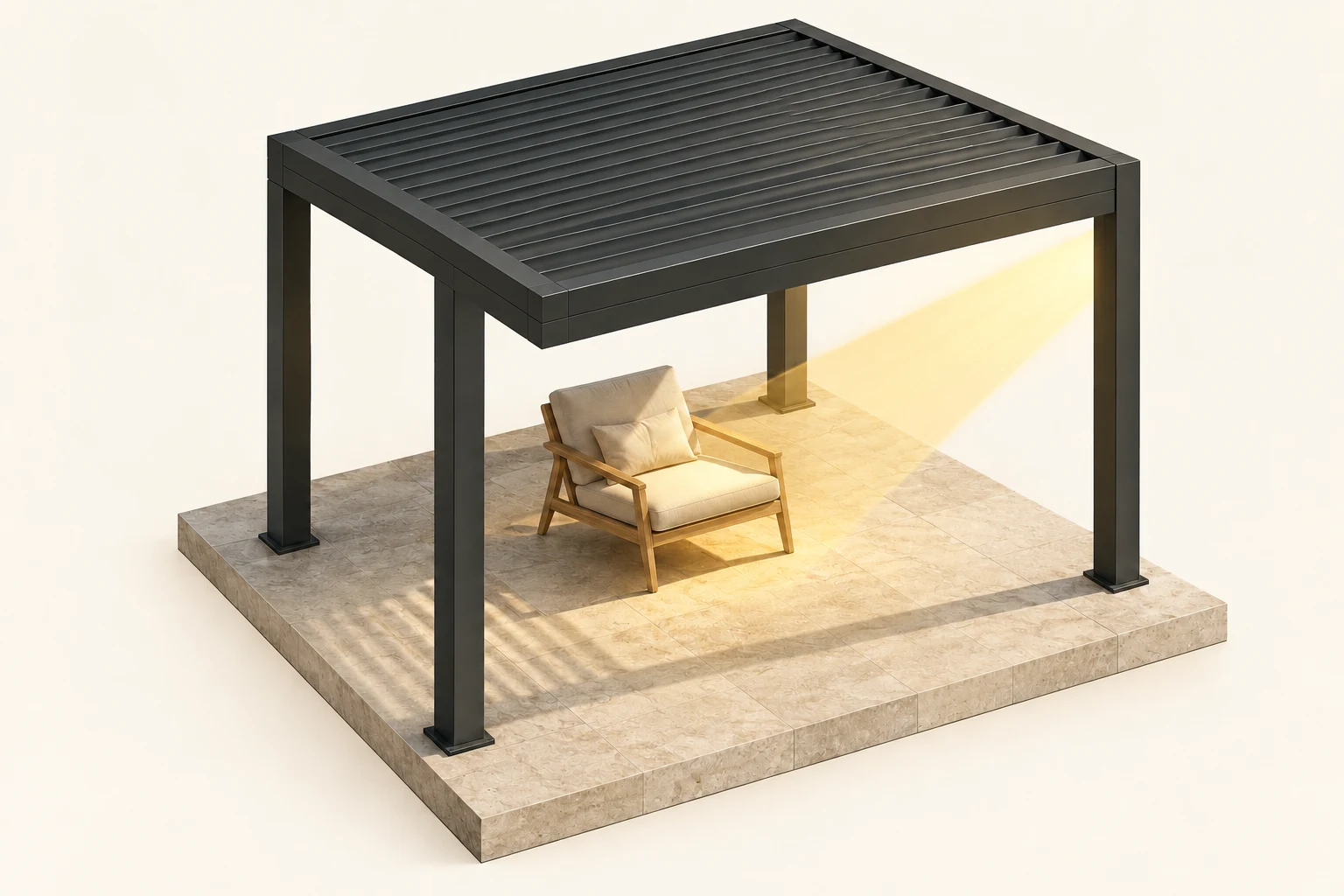
Trace the sunlight to the place you want to use—not simply to the center of the roof. Sun reaching a chair through an open side is a different problem from sun passing between tilted louvers. A larger opening range cannot solve every exposed-side condition.
The DOE Building America window guide explains that overhead shading is less effective against the lower-angle sun on east and west exposures. For a pergola, check side exposure during your actual hours of use rather than assuming overhead coverage is sufficient.
Make a use-time worksheet before shopping
Draw the house wall, doors, trees, boundaries and proposed table or chairs. Add a north reference from a reliable site plan or map. Mark two or three times you genuinely want to use the patio—for example breakfast, lunch and the period after work. The times are your choices, not universal test hours.
At those times, take photos from the same seating position and record where direct sun reaches you. Include the date. One afternoon’s observations describe that afternoon, not the entire year; for a seasonal purchase or a shaded site, ask a designer for a date-specific sun-path assessment that includes surrounding obstructions.
| Record | Your observation | What it changes |
|---|---|---|
| Activity and date/time | Eating, reading or lounging; actual planned hours | Defines the area and season that must work. |
| Sun reaching the seat | Through the roof area, from a side, or already blocked | Separates roof adjustment from side-shade needs. |
| House and landscape | Wall, roofline, trees and neighboring structures | Shows what already blocks light or restricts placement. |
| Alternative layout | Move the seat, rotate the allowed frame or add a compatible screen | Creates a comparison before ordering. |
| Uncertainty | Missing season, unknown louver axis or unverified screen fit | An open question to resolve, not a promised result. |
Compare only layouts the manufacturer allows
Keep the furniture and use-time goal identical when comparing two layouts. Otherwise, a drawing can appear better simply because the chair moved out of the difficult spot. For each allowed louver axis, ask how the actual roof can shade the target area while preserving the openness you want.
Do not choose from a compass diagram alone. Include roof height, louver profile and permitted travel, side exposure, walls and the adjacent room’s daylight. If a seller provides a shadow study, request the location, date, time and modeled product configuration so you can tell whether it answers your question.
- Confirm whether the louver axis is fixed within the purchased kit.
- Check the actual frame dimensions in each permitted placement.
- Keep the target seating area and use time constant.
- Compare side-screen needs and house daylight as well as overhead shade.
- Save assumptions beside the drawing so they are not mistaken for results.
Use product specifications as inputs—not shade scores
The Mirador 80S 10 × 10 Latte page lists a 90-degree opening angle. Its nominally square footprint may be a practical starting point for a compact patio. The angle describes roof travel; shade still depends on the seat and site. Confirm the installed louver axis separately.
The Mirador 111S E-Motion 10 × 13 Charcoal page lists remote roof control and a 0–93-degree opening range. It illustrates the convenience decision separately: you may prefer easier adjustment during the day. Neither this range nor the motor establishes a superior shade outcome without the site and layout information above.
Choose roof direction and side protection together
If the troublesome sun comes through a side at your preferred time, investigate a compatible side screen or a different seating position before paying for a more elaborate roof. If your priority is daylight in an adjacent room, include that room in the observation worksheet instead of optimizing only the outdoor seat.
Your final brief should state the activity, target area, important dates and times, permitted roof orientation and remaining side-shade needs. Choose the exact kit only after those constraints fit. Use that brief to compare the product examples against your own patio.
Sources & methodology
Manufacturer documentation and technical references checked 2026-10-31. Our research method.