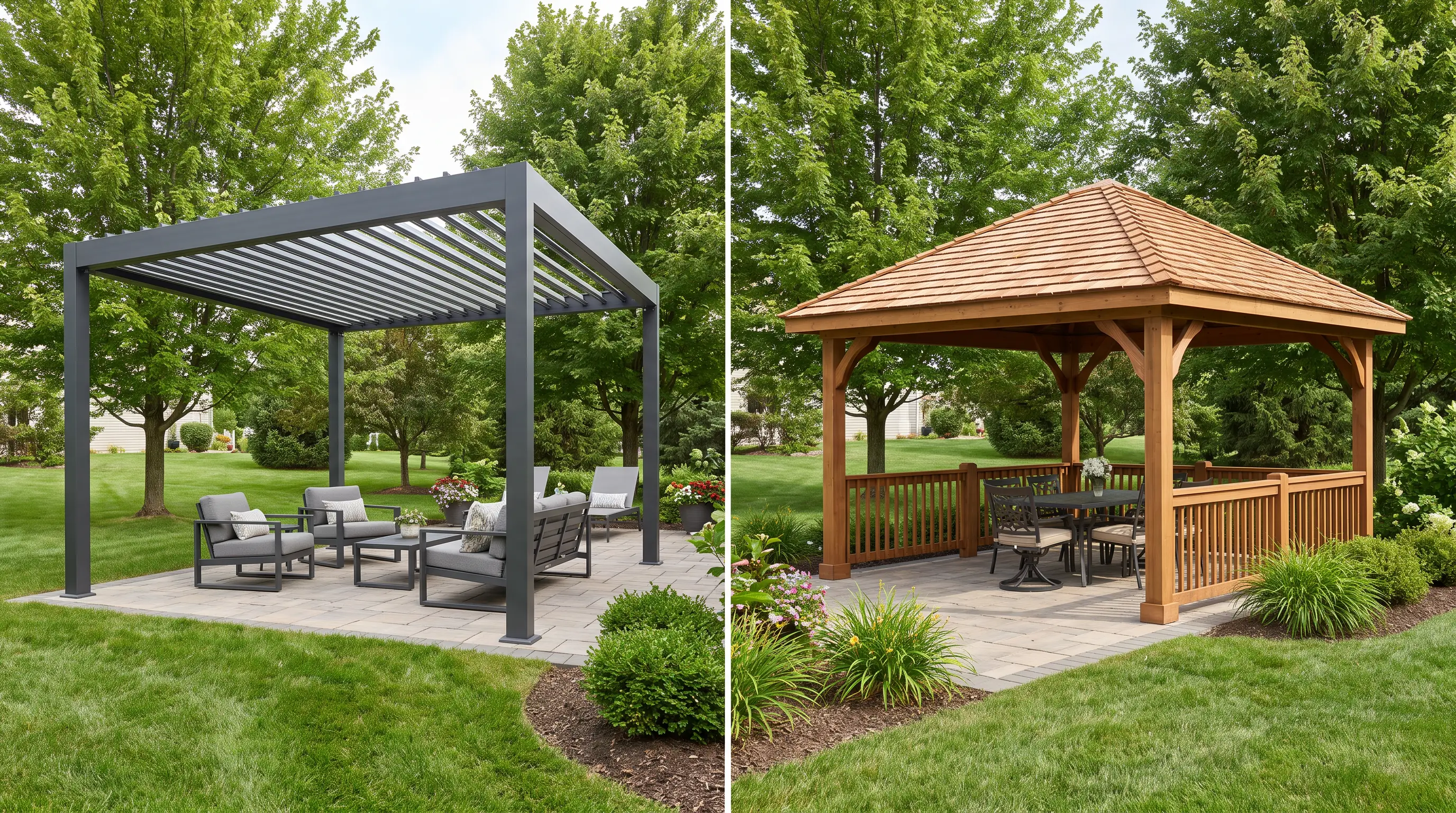
Pergola vs. Gazebo: Which Outdoor Structure Fits Your Backyard?
Choose a pergola when adjustable or partial overhead openness is part of the experience; choose a gazebo when a fixed, continuously covered roof is the core requirement. Modern louvered pergolas blur the line, so compare the exact roof behavior, weather evidence, ventilation, site fit, and installation rather than relying on the category name alone.
By MyPergolaMatch Research · Updated 2026-09-09
Compare roof behavior first
The roof determines how the outdoor room behaves. A traditional open pergola filters sun but does not create a continuous rain roof. A louvered pergola can change between more open and more closed states. A gazebo typically prioritizes constant coverage.
If you begin with the label instead of the roof behavior you need, it is easy to compare products that solve different problems.
Pergola tends to fit when…
- Adjustable openness matters
- You want a lighter architectural feel
- Airflow and controllable shade matter
- A louvered or open roof fits the project
Gazebo tends to fit when…
- A solid roof is the priority
- You want constant overhead cover
- Traditional roof form fits the site
- Adjustability is not important
Think about the space on a typical day
Ask whether you want open sky, adjustable sun, constant shade, rain cover, ventilation above a grill or hot tub, or a roof that never moves. Then consider furniture layout, door access, views, pool clearance, and how often the space will be used outside peak summer.
Installation can matter more than the category
Both pergolas and gazebos can become permanent structures that need a suitable foundation, anchoring, permits, or engineering depending on the site and jurisdiction. Motorized pergolas can add electrical work, while large fixed gazebos can add heavier roof and foundation demands.
A simple decision rule
If adjustable overhead openness is a high-value feature, start with pergolas. If a fixed roof is non-negotiable, start with gazebos or fixed-roof pergolas. Then compare actual dimensions, weather documentation, foundation requirements, total installed cost, and maintenance before choosing the final product.
The quick answers.
What is the main difference between a pergola and a gazebo?
Traditionally, a gazebo uses a fixed solid roof while a pergola uses an open or slatted roof. Modern louvered and fixed-roof pergolas make that distinction less clean, so roof behavior is more useful than the product label.
Which gives better rain protection?
A fixed solid gazebo roof provides continuous overhead coverage by design. Some closed louvered or fixed-roof pergolas can also manage rain, but the exact drainage and weather claim should be verified for the product.
Which is cooler in summer?
Comfort depends on shade, roof color, ventilation, orientation, surrounding walls, and climate. An open or adjustable pergola can increase ventilation; a fixed roof can block more direct sun. Neither category guarantees a cooler space.
Which is cheaper?
Category names do not determine total cost. Size, material, roof mechanism, engineering, foundation, installation, electrical work, and accessories can matter more than whether a listing calls the structure a pergola or gazebo.
Sources & methodology
We use manufacturer and primary product sources where possible, keep unknown values unknown and do not claim hands-on testing unless it happened. Read the full methodology.